Introduction
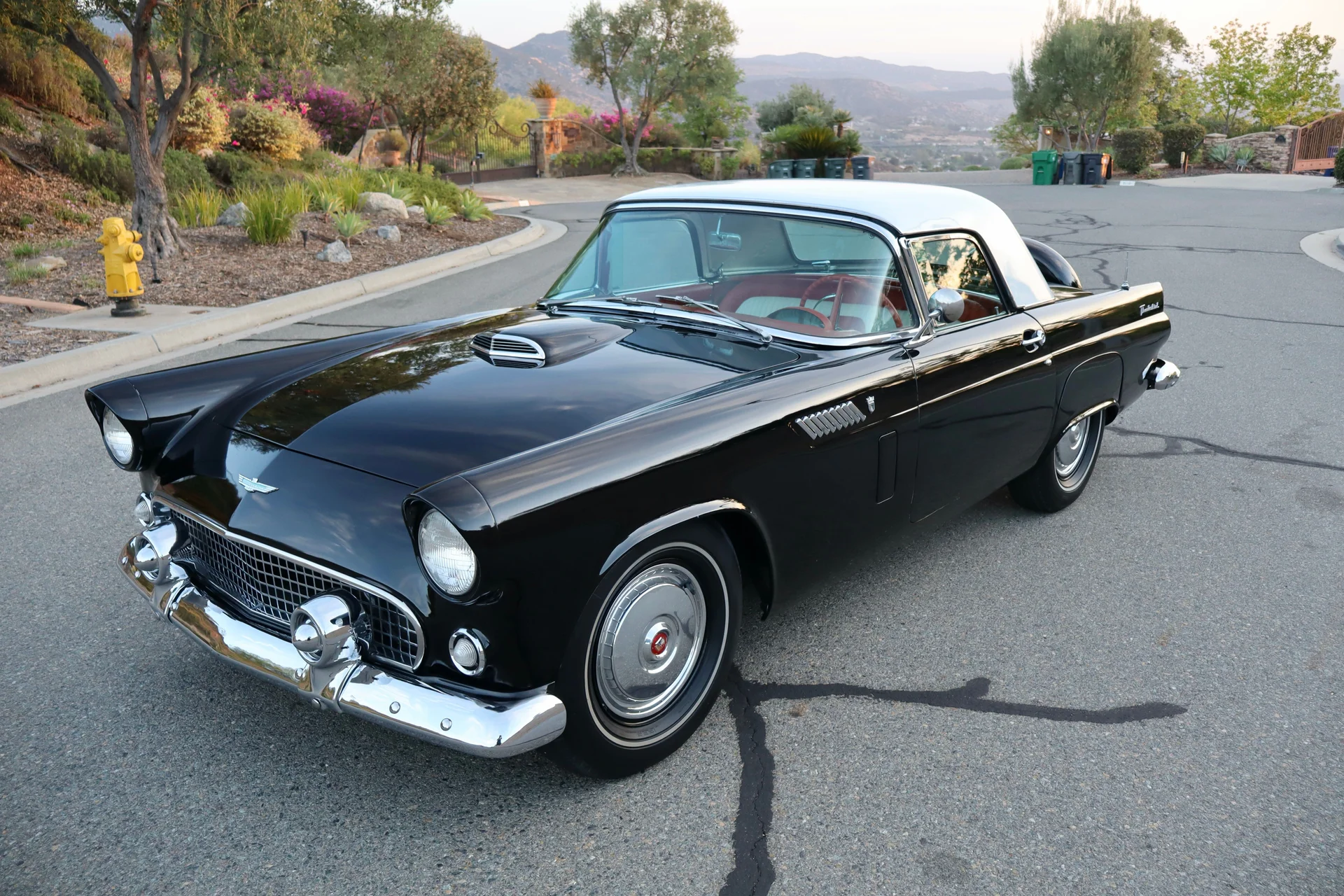
A classic advertised in the United States for USD 20,000 can look very attractive when converted directly into dirhams. USD 20,000 is about AED 73,450 at the UAE dirham's dollar peg. But that is not what the car will cost you in Dubai.
Before the car is standing outside your home or workshop, you may also have paid for a pre-purchase inspection, transport across the United States, export handling, ocean freight, marine insurance, UAE customs duty, VAT, port and clearance charges, local transport, inspection and whatever recommissioning the car needs after arrival.
That is why the useful number is not the purchase price. It is the cleared and delivered cost, followed by the realistic road-ready budget.
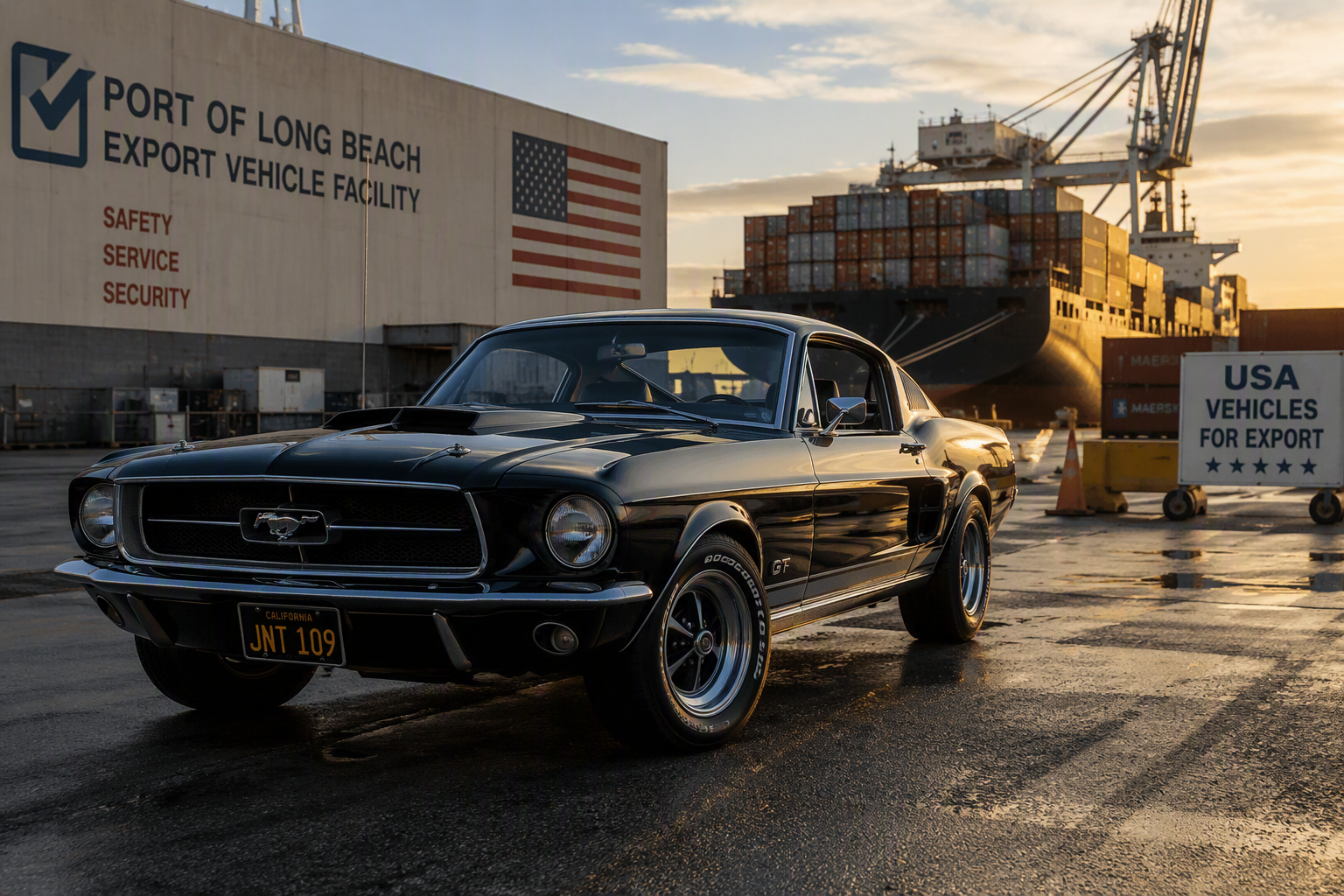
The advertised price is only the first line in the import budget.
1. The cost stack starts long before the ship leaves America
A sensible UAE buyer should think of the transaction as a stack of costs rather than one shipping quote.
Cost - What to budget for |
Vehicle purchase - The agreed price paid to the seller
Pre-purchase inspection - Around USD 330 for a published classic-car mobile inspection; deeper specialist inspections can cost more
US inland transport - From a few hundred dollars near a port to USD 1,500–2,400+ for long-distance moves
Export/forwarder handling - Often bundled into freight; if separate, allow roughly USD 300–700
Ocean freight - Roughly USD 1,700–2,400 RoRo, USD 1,800–2,500 shared container, or USD 3,000–4,200 dedicated 20-ft container for a normal running car on favorable routes
Marine insurance - Often around 1.5–2.5% of insured value in specialist international-auto pricing
UAE customs duty - 5% of accepted CIF customs value
UAE VAT - 5% on the customs value plus customs duty
Port clearance - A practical planning allowance of roughly AED 2,000–5,000 before storage or demurrage
Local transporter - Commonly a few hundred dirhams for a normal car into Dubai
Inspection / registration - Relatively small compared with the logistics stack, but still required where applicable
Post-arrival reserve - Potentially anything from a few thousand dirhams to tens of thousands depending on condition
The first trap is assuming that all these costs rise in proportion to the purchase price. They do not. A USD 10,000 car still needs one inspection, one truck to the export point, one export process, one shipping space, one customs clearance and one registration process. That is why cheaper classics can become disproportionately expensive by the time they reach the UAE.
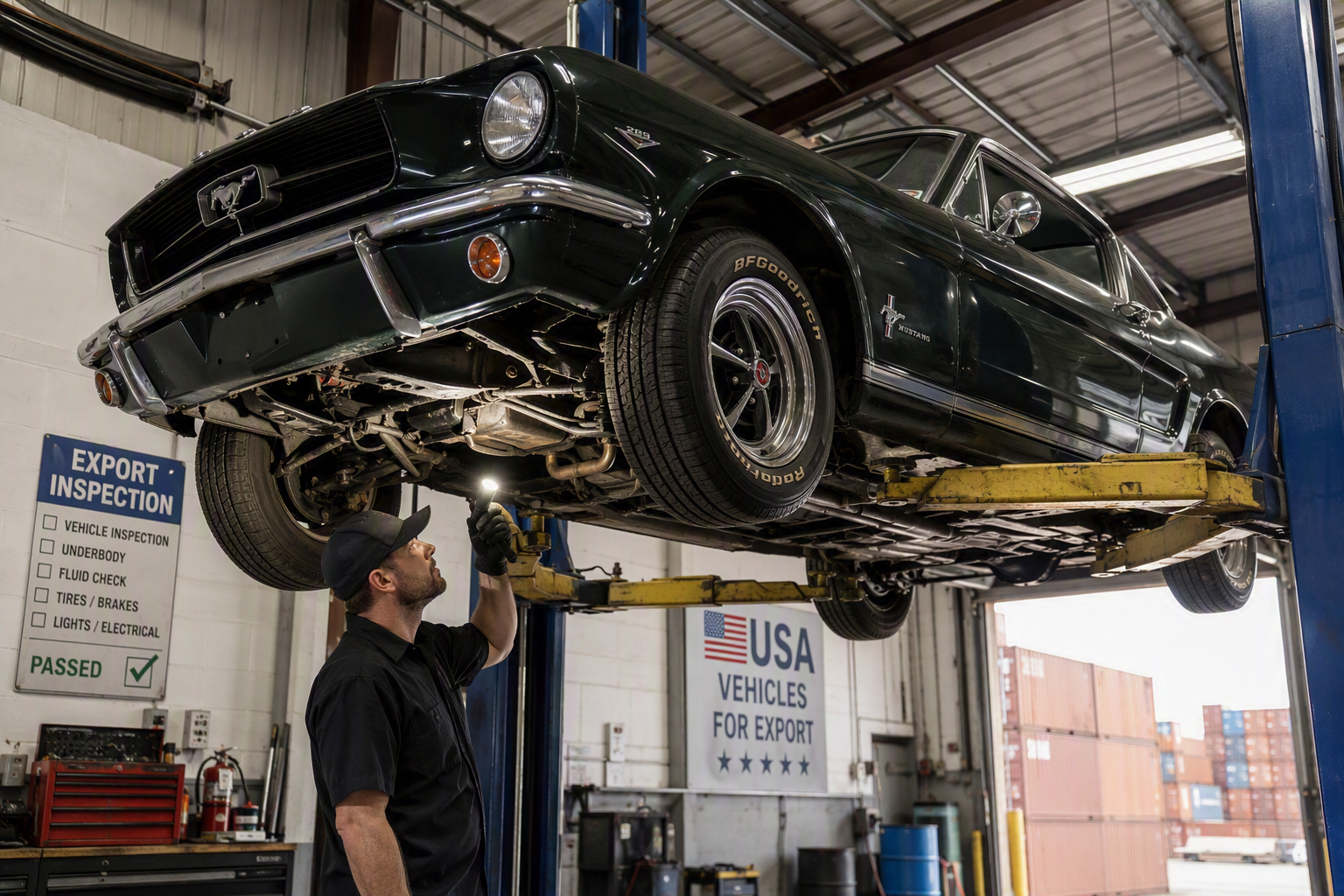
An independent inspection is one of the smallest costs in the transaction — and one of the most useful.
CLASSICS R US INSIGHT: A cheap car is not automatically a cheap import. Fixed and semi-fixed logistics costs can overwhelm the saving on a low purchase price.
2. Where the car is in America matters more than many buyers expect
Two identical cars advertised for exactly the same price can have very different UAE landed costs. A car sitting close to New Jersey, Houston, Florida or Southern California may be only a short truck journey from an export gateway. A car deep in the Midwest may need hundreds or thousands of miles of domestic transport before international shipping even begins.
Current US carrier benchmarks put open transport roughly in these ranges:
Distance - Typical planning range
Short move near export gateway - USD 300–600
Around 500 miles - USD 800–1,300
Around 1,000 miles - USD 850–1,250
Around 2,500 miles - USD 1,500–2,400+
Enclosed transport commonly costs around 30–60% more and may be sensible for a high-value, fragile or freshly restored classic.
Then comes the ocean leg. For a normal running car, current commercial UAE-lane estimates are roughly:
- RoRo: USD 1,700–2,400
- Shared container: USD 1,800–2,500
- Dedicated 20-ft container: USD 3,000–4,200
The interesting part is that shared-container pricing can now sit surprisingly close to RoRo. In some cases the difference is only a few hundred dollars. A non-running car changes the picture again. It can lose access to the cheapest RoRo options and add winching, forklift, loading and special inland-transport costs. Large pickups, SUVs and full-size American classics can also cost more because they occupy more shipping space.
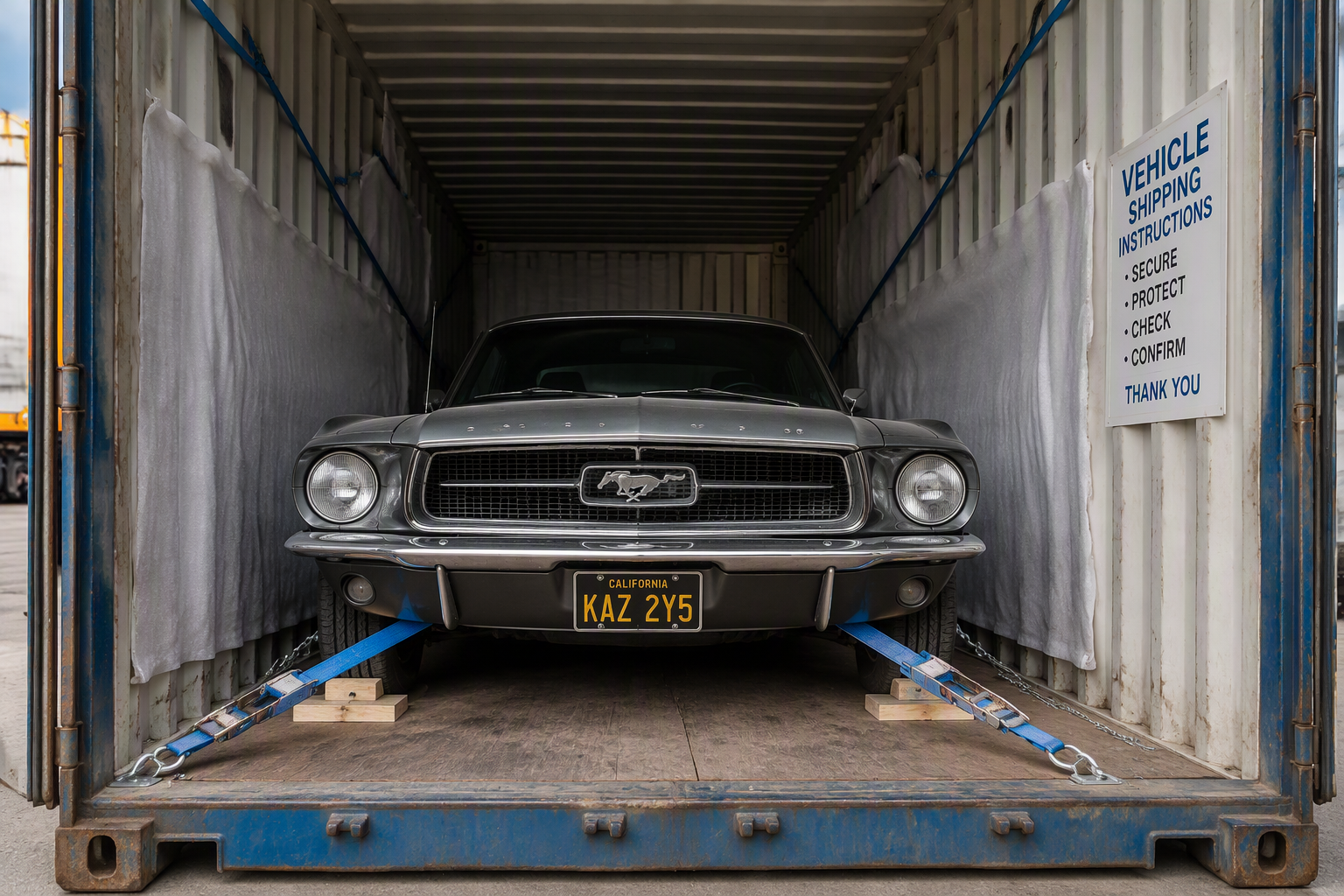
Shipping mode matters, but the car's US location, size and running condition can matter just as much.
3. The UAE tax calculation is simple — but it is not just “10%”
Dubai Customs normally applies 5% customs duty to the accepted CIF customs value. CIF means the customs value is not simply the seller's invoice. It can include the vehicle cost together with freight, insurance and relevant transport costs up to the UAE place of importation.
VAT is then normally 5% on the customs value plus the customs duty. So if the accepted customs value is AED 100,000:
Customs value - 100,000
Customs duty @ 5% - 5,000
VAT base - 105,000
VAT @ 5% - 5,250
Total duty + VAT - 10,250
In that simple case, customs duty and VAT together equal 10.25% of customs value, not exactly 10%. There is another point buyers should understand: Dubai Customs can ask for supporting evidence if it doubts the declared transaction value. A genuine bargain is perfectly possible, but the buyer should keep the purchase agreement, invoice, payment evidence, seller correspondence and useful condition evidence. A very low invoice does not automatically force Customs to accept that value without question.
After tax, there are destination costs such as the customs declaration, Vehicle Clearance Certificate, clearing-agent fees, delivery-order charges, terminal handling, container deconsolidation where applicable and local transport. For a straightforward car, a practical allowance of around AED 2,000–5,000 for normal Jebel Ali destination and clearance charges is more useful than pretending there is one universal port tariff.
Storage and demurrage are different. If documents are missing or clearance is delayed, those charges can escalate quickly and depend on the carrier, terminal and booking terms.
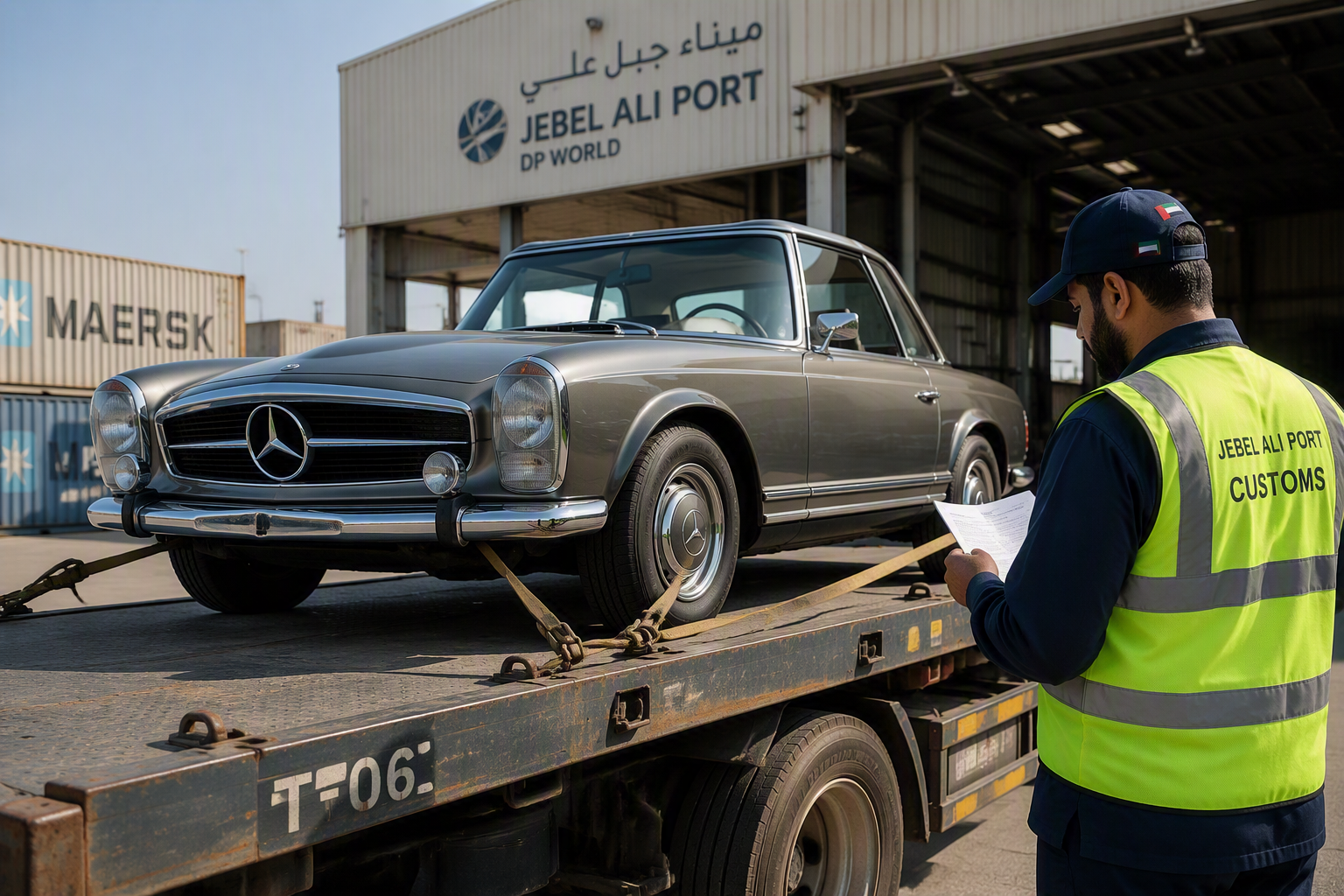
Arrival in the UAE is not the end of the cost stack. Customs, VAT, clearance and local transport still sit between the port and your garage.
CLASSICS R US INSIGHT: Customs is usually one of the more predictable parts of the budget. The bigger surprises are often US inland transport, port delays, condition problems and post-arrival recommissioning.
4. What does a USD 20,000 classic really become in Dubai?
This is the number most buyers actually want. Take a hypothetical running USD 20,000 classic in reasonable condition, located sensibly for export and shipped in a shared-container-type arrangement. Using the research assumptions below:
Cost - Approx. amount
Purchase price - USD 20,000
Classic-car PPI - USD 330
US inland transport - USD 700
Export administration - USD 400
Ocean freight - USD 2,000
Marine insurance - USD 350
By the time the vehicle reaches Jebel Ali, the model is approximately: AED 87,300 arrived at port. After customs duty, VAT, ordinary clearance costs and local transport: approximately AED 99,500 cleared and delivered. Then allow for inspection/registration and keep around AED 10,000 aside for sensible initial recommissioning: approximately AED 110,000 as a realistic first road-ready budget before buyer-specific UAE motor insurance
That is the mental conversion worth remembering: USD 20,000 advertised price → around AED 100,000 cleared and delivered → around AED 110,000 with a sensible initial reserve. It is not a quotation. A car close to port with excellent recent service history may cost less. A non-runner 1,500 miles inland with old tires, cooling problems and missing documents can cost substantially more.
Three useful examples
| US purchase price | Cleared & delivered | Road-ready budget incl. reserve |
| USD 15,000 | approx. AED 77,700 | approx. AED 86,100 |
| USD 30,000 | approx. AED 147,000 | approx. AED 163,000 |
| USD 50,000 | approx. AED 235,800 | approx. AED 256,800 |
The percentages fall as the car becomes more valuable because many logistics costs are fixed or semi-fixed. In these examples, the USD 15,000 car ends up roughly 56% above its purchase price once a modest reserve is included. The USD 50,000 car ends up around 40% above purchase price despite using more expensive shipping protection. That is the economics behind the cheap-classic trap.
The figure that matters is not what the car cost in America. It is what it costs once it is usable in the UAE.
How much should you keep aside after the car arrives?
There is no honest universal percentage. A better approach is to budget according to the car you are actually buying.
| Type of classic | Sensible post-arrival reserve |
| Excellent, recently serviced car with strong records and PPI | AED 5,000–10,000 |
| Normal driver-quality classic with some deferred maintenance | AED 10,000–20,000 |
| Unknown-history, long-stored, non-running or project car | AED 25,000–60,000+ |
| Rusty restoration or major drivetrain candidate | No sensible fixed ceiling |
That reserve might disappear into tires, brakes, cooling, fuel-system work, hoses, leaks, electrical faults, air conditioning or suspension. Or the car may arrive better than expected and use very little of it. The point is not to spend the reserve. The point is to have it.
Conclusion
The mistake is not buying a USD 20,000 classic in America. The mistake is thinking that USD 20,000 is the number you are buying. For a UAE buyer, the real decision should be made using the cleared and delivered cost, followed by a realistic allowance for inspection, registration and the work an old car may need after arrival.
As a rough first-pass planning rule, a straightforward running classic in the USD 20,000–50,000 range may require something like 25–35% above purchase price to reach cleared/delivered territory, and 35–50% above purchase price for a more conservative road-ready budget with a modest recommissioning reserve. But percentages are only a starting point. The smarter calculation is always car-specific:
Where is it? Does it run? How will it ship? What will Customs value? What condition is it really in? And what will it need once it reaches the UAE? - Get those answers before you buy, and the landed cost stops being a surprise.
CLASSICS R US INSIGHT: The cheapest car is not always the cheapest car to own in the UAE. The right comparison is not US asking price versus UAE asking price — it is the realistic cleared, delivered and road-ready cost of the individual car.
If you are considering a classic overseas and want help understanding the real UAE landed cost before you commit, contact Classics R Us by phone or WhatsApp
IMPORTANT INFORMATION: Costs in this Guide are based on official UAE requirements and published commercial pricing available in August 2026. Freight, insurance, port charges, US inland transport, taxes, clearance costs and recommissioning needs can vary materially by vehicle, origin, shipping method, service provider and current market conditions. Illustrative commercial ranges are not quotations or government tariffs. UAE customs valuation and registration eligibility are determined by the relevant authorities, and buyer-specific UAE motor insurance is not included in the worked road-ready examples.
Source basis: Research dated 19 August 2026 using primary UAE sources including Dubai Customs, UAE VAT legislation, MoIAT and RTA; US government sources including CBP and Census/AES; and current specialist commercial sources for shipping, inspection, inland transport and marine insurance. Commercial figures are planning ranges, not government tariffs.
Editorial note: Freight, carrier surcharges, port charges and insurance pricing can change quickly. Obtain live written quotes before committing to a vehicle.