Original, Restored, Restomod or Replica? What Are You Actually Buying?
Two classics can look almost identical in photographs and be fundamentally different cars. Before paying for originality, rarity or pedigree, establish what the vehicle actually is — and whether its identity, history, modifications and price tell the same story.
Introduction
“Original.”
“Matching numbers.”
“Fully restored.”
“Restomod.”
“Tribute.”
“Recreation.”
“Replica.”
These words appear constantly in classic-car advertisements, but they do not all describe the same thing — and they are not always used consistently.
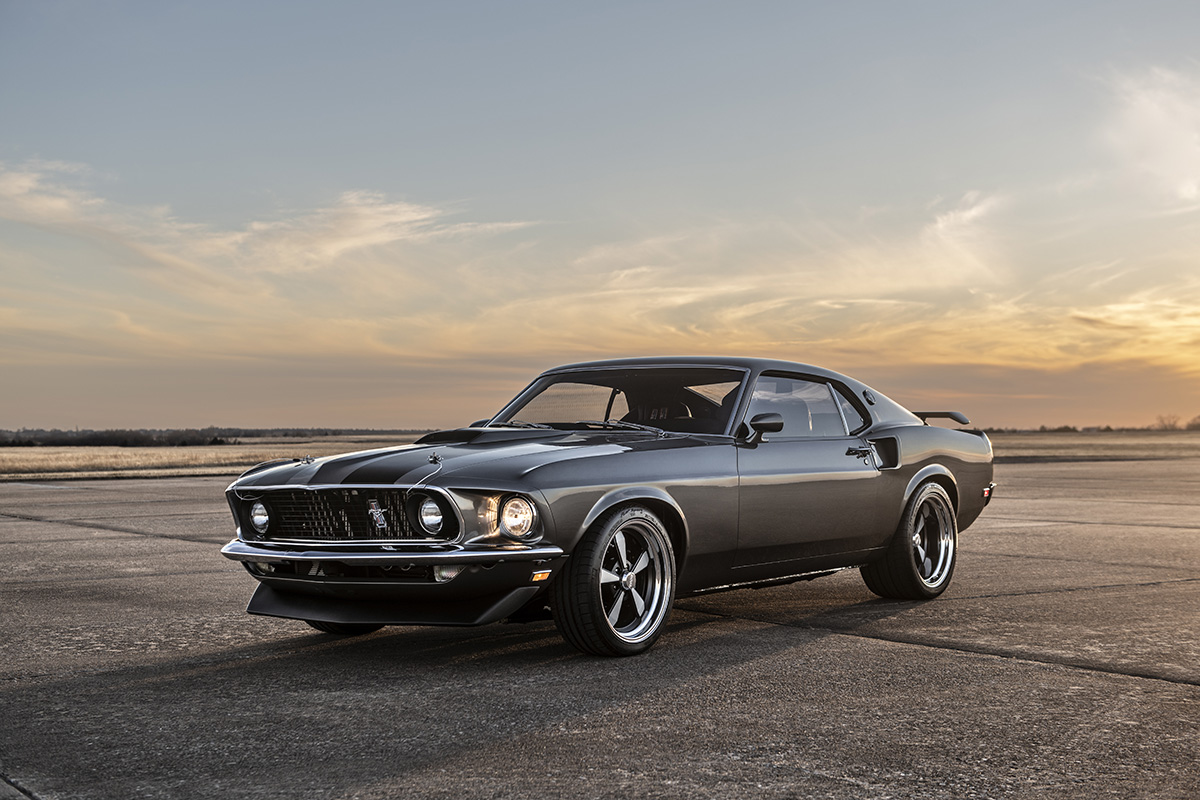
A 1969 Mustang that looks like a Mach 1 might be a genuine factory Mach 1, a standard fastback converted to Mach 1 appearance, or even a coupe later converted into a fastback. A Cobra-shaped car might be an original Shelby, a continuation car, a professionally built replica or a kit assembled around donor components.
All of them could be excellent cars. They should not necessarily have the same value.
For a UAE buyer shopping overseas, the objective is therefore not to decide that “original is good” and “modified is bad”. It is to establish what the car actually is, how much of its claimed identity can be supported, what has changed since it left the factory, and whether the asking price reflects those facts.
There is one additional UAE consideration. Major changes to an engine, body or vehicle structure may also affect the inspection and registration path after the car arrives.

Original, restored, modified and replicated classics can all be desirable. The important thing is knowing which one you are buying.
1. Separate identity, originality, condition and quality
These four ideas are often mixed together. They should not be.
Identity asks what the vehicle fundamentally is: model, body style, derivative, chassis and documented history. Originality asks how much of the car and its original specification remain. Condition asks how good the car is today. Quality asks how well any restoration, repair or modification has been executed. A tired survivor can have strong identity and originality but poor condition. A beautifully restored car can have excellent condition while containing extensive replacement metal and a replacement drivetrain. A restomod can be almost entirely non-original mechanically yet be engineered and finished to an exceptional standard. A replica can be a superbly built car while having no claim whatsoever to the identity of the original model it resembles.
The Antique Automobile Club of America’s current judging framework illustrates the distinction well. Its preservation programme recognizes vehicles maintained for originality, while its judged classes separately consider authenticity, workmanship and condition. A significantly restored vehicle does not remain an original-preservation car merely because the restoration is excellent.
That is a useful principle even if you never intend to enter a concours. Do not let beautiful condition answer an identity question.
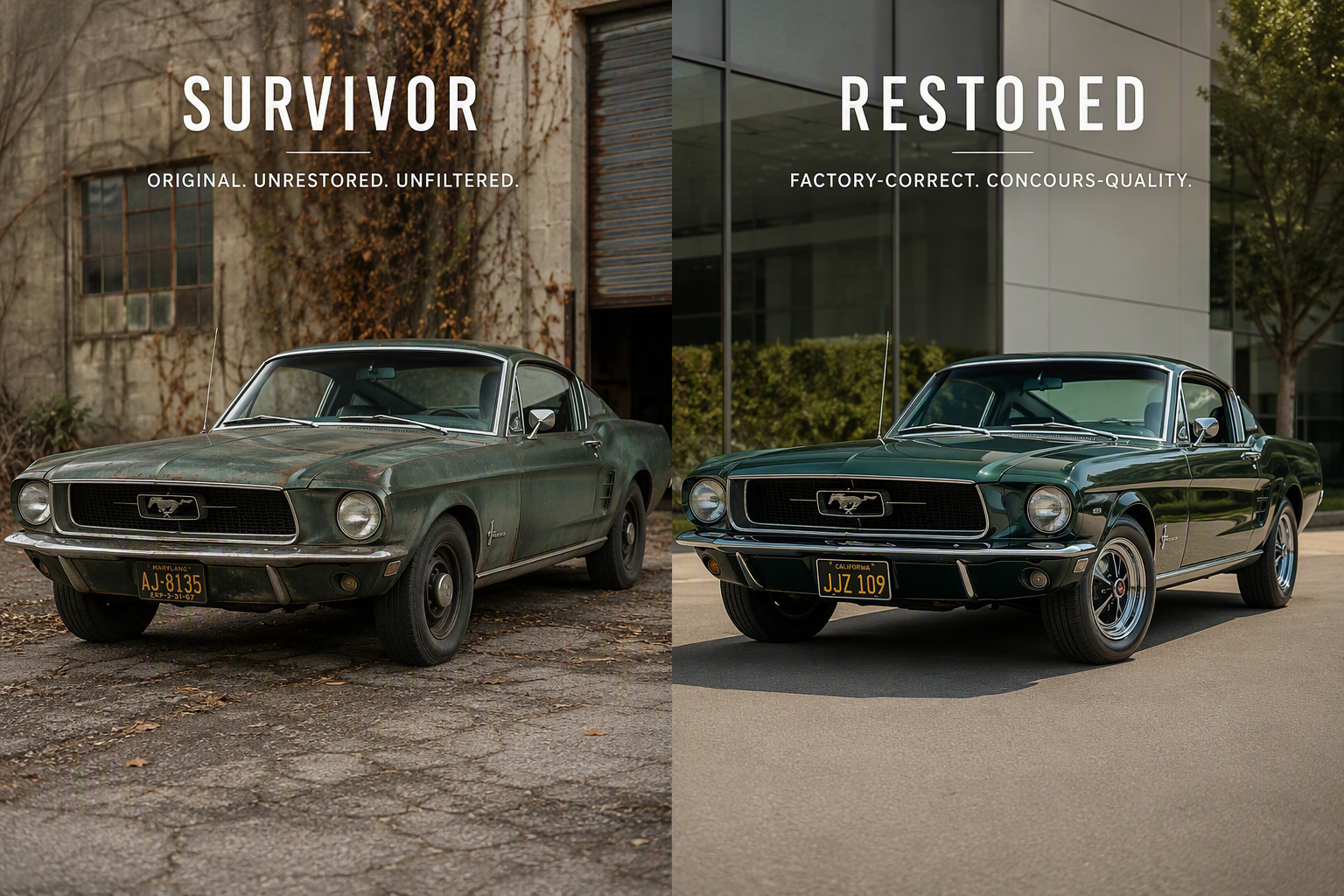
The shinier car is not automatically the more original car — or the more valuable one.
CLASSICS R US INSIGHT: When a seller says “original”, ask what they mean. Original identity? Original engine? Original body panels? Original colour? Original interior? Original paint? Those are six different claims.
2. “Original” is not one simple category
Very few old cars remain exactly as they left the factory. Engines are rebuilt. Clutches wear out. Paint deteriorates. Upholstery tears. Windscreens break. Suspension bushes, exhausts, alternators, water pumps and brake components are replaced.
That does not automatically destroy a classic’s identity or desirability. The useful question is what has changed, and how important is it for this particular car?
For a common 1970s cruiser, replacement consumables and sensible maintenance may have almost no negative effect on desirability. For a highly valuable performance derivative whose price depends heavily on factory specification, the original engine, body configuration and documented provenance may matter enormously.
If originality affects the price, break the claim down.
Ask: - Is this the body/chassis the vehicle was built with? - Is the current body style the factory body style? - Is the engine believed to be original to this particular car? - Is the transmission original? - Is the current colour the factory-delivered colour? - Is the interior original material, correctly restored material or a later redesign? - Which major body panels have been replaced? - Has the car ever been structurally reconstructed? - Which modifications can be reversed?
Then ask what evidence supports the answers. Factory build records, heritage certificates, historic registrations, old photographs, service records, restoration invoices, marque registries and physical identification numbers can all contribute.
No single document necessarily proves everything.
3. “Matching numbers” needs evidence, not faith
“Numbers matching” is one of the most valuable phrases in some parts of the collector-car market. It is also one of the easiest phrases to misunderstand. Manufacturers did not all identify engines, transmissions and bodies in the same way.
On some cars, a vehicle-specific number or derivative of the VIN was stamped onto major components. On others, buyers may rely on engine serial numbers, casting numbers, casting dates, assembly codes and factory records to determine whether components are original or merely period-correct. That distinction matters.
An engine manufactured in the correct year and of the correct type may be period-correct without being the engine originally installed in that particular car.
Hagerty’s guidance on authenticity recommends building a paper trail, checking chassis numbers against documentation, examining tags for signs of tampering and using marque-specific records and experts where appropriate.
For a valuable car, photographs of a stamping are not always enough. A marque specialist may need to consider: - the location of the stamping; - font and character style; - machining marks; - casting dates; - component codes; - whether the sequence makes sense for the production date; - whether factory or registry records support the claim.
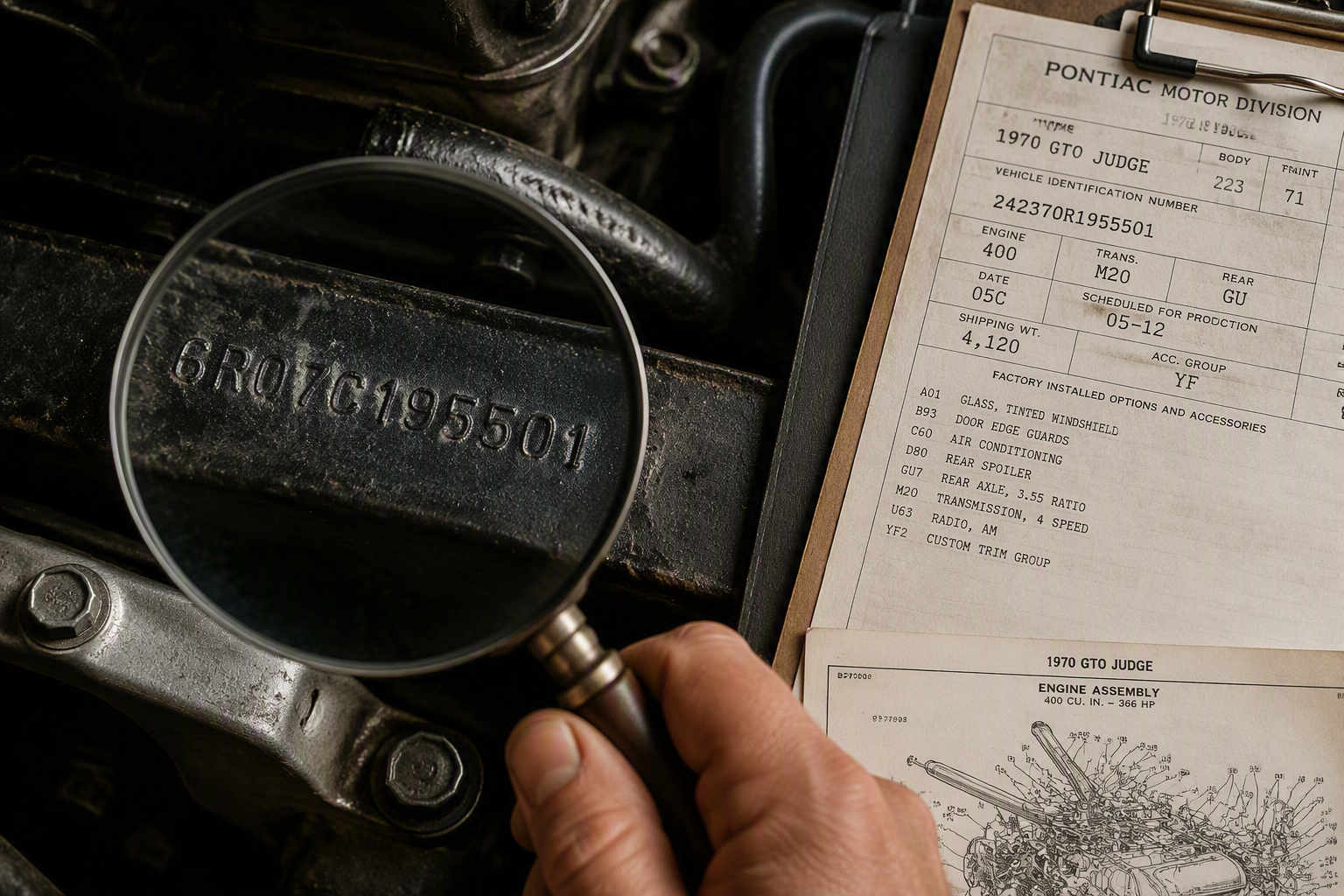
The greater the premium attached to “matching numbers”, the stronger the verification should be.
CLASSICS R US INSIGHT If “matching numbers” adds a meaningful amount to the asking price, treat it as a claim that needs specialist verification not as a decorative phrase in the advertisement.
4. Survivor, restored and over-restored are different things
A survivor is generally understood to be a substantially preserved car retaining significant original material rather than having undergone comprehensive restoration. There is no universal commercial definition.
A credible survivor might still have had mechanical maintenance, local paint repairs, replacement tyres and normal wear items. What makes it interesting is the survival of meaningful factory material and evidence. Original paint may show checking and fading. Original leather may be creased. Factory seams, spot welds, overspray, labels, fasteners and finishes may look imperfect compared with a modern restoration. Those imperfections can be evidence.
A restored car has undergone work intended to return it towards an earlier or factory-correct state. But “fully restored” tells you almost nothing about the quality of that work. One restoration may involve careful corrosion repair, correct metalwork, documented drivetrain rebuilding, proper finishes and hundreds of photographs. Another may involve filler, fresh paint, new seat covers and black coating sprayed across the underside. Ask who restored the car, when, to what standard and with what documentation.
Restoration photographs are particularly valuable because they can reveal what the finished paint no longer can. An over-restored car is generally one finished beyond the materials, finishes or presentation it would realistically have received when new. That may make it spectacular to look at, but it does not make it more authentic.
AACA judging guidance specifically centres authenticity on how a vehicle could reasonably have appeared when delivered rather than rewarding arbitrary extra shine.
5. A restomod is not a failed original
A restomod deliberately combines a classic vehicle with modern or upgraded systems. Typical changes include: - electronic fuel injection; - modern engines; - overdrive ransmissions; - upgraded brakes; - revised suspension; - power steering; - improved cooling; - modern air conditioning; - upgraded wiring; - modern seats and seatbelts; - improved lighting; - contemporary wheels and tyres; - discreet infotainment, cameras and other electronics.
For a car intended to be driven regularly in the UAE, some of those changes can be extremely attractive. Cooling matters in summer. Effective air conditioning matters. Brakes, steering, highway gearing and reliable starting matter. A factory-correct car may have greater historical originality while a well-built restomod may be considerably more enjoyable in modern traffic. Neither is automatically “better”.
The crucial issue is whether the buyer understands what has been changed and whether the engineering quality justifies the price. Modification invoices are not the same thing as market value. A seller may have spent US$100,000 modifying a US$30,000 car. That does not automatically create a US$130,000 car.
Conversely, a professionally engineered restomod from a respected builder may command a substantial premium because buyers value the workmanship and driving experience.
Judge the finished car, not merely the receipts.
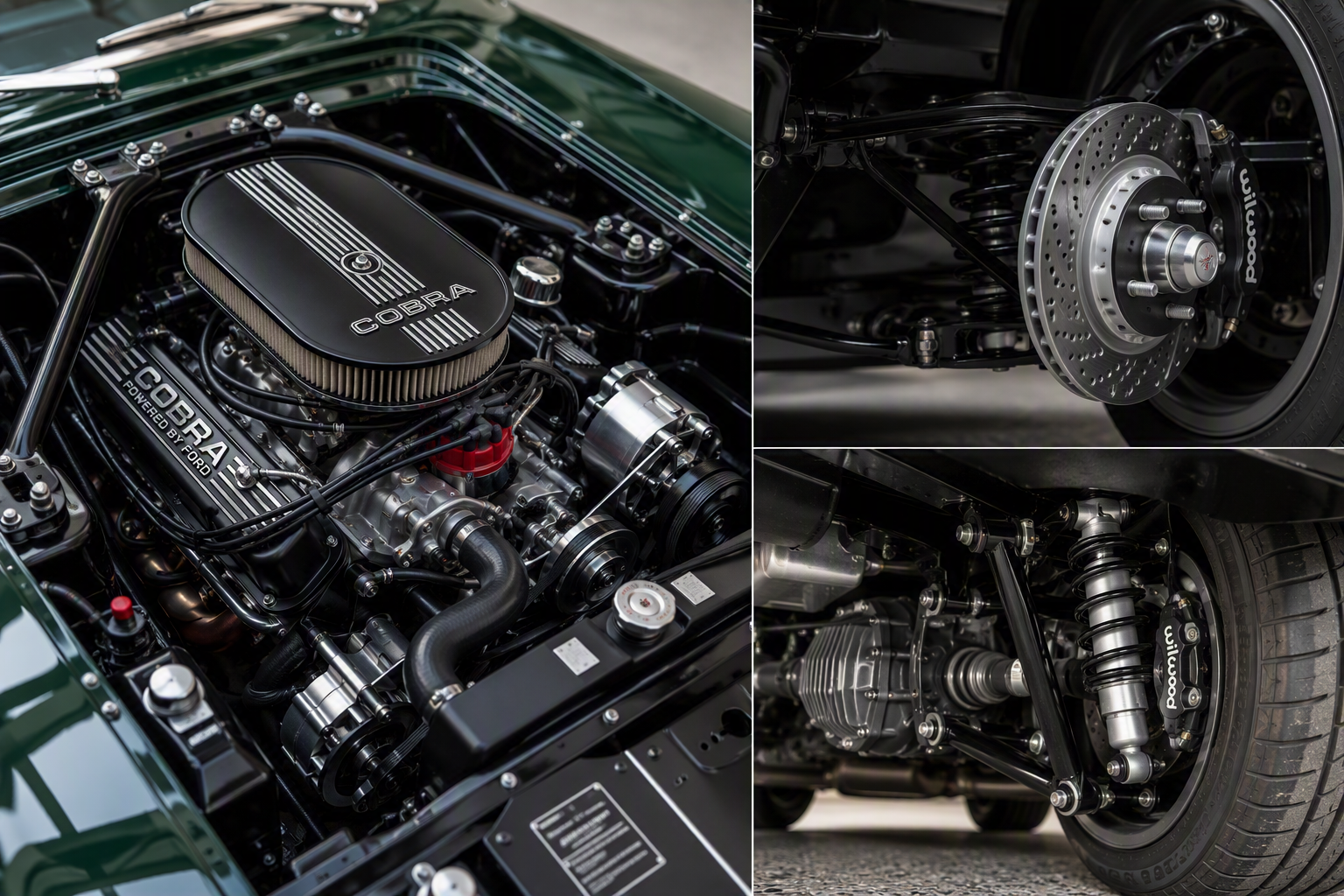
A restomod should be assessed as an engineered package. Expensive components do not compensate for poor integration.
Inspect the engineering, not the parts list
For a modified car, pay particular attention to:
- engine and transmission mounts;
- welding and fabrication;
- cooling capacity;
- fuel-system routing;
- exhaust clearance and heat management;
- steering geometry;
- brake balance and assistance;
- suspension geometry;
- driveline angles;
- wiring and fuse protection;
- tyre clearance;
- structural reinforcement;
- quality of fasteners and plumbing.
A famous engine, expensive coilovers and large brakes do not automatically make a coherent car.
CLASSICS R US INSIGHT Do not pay an originality premium for a car you intend to modify immediately. Equally, do not pay a restomod premium merely because somebody spent heavily. Buy the specification you actually want, then judge the quality of its execution.
6. Tribute and clone: the appearance can be genuine while the pedigree is not
A tribute or clone normally begins as a genuine production car and is modified to resemble a more desirable derivative. Examples are easy to find:
- a standard Mustang dressed as a Mach 1 or Shelby;
- a regular Charger converted to R/T appearance;
- a Camaro recreated as an SS or Z/28;
- a standard Porsche modified to resemble a rarer performance model.
There is nothing inherently wrong with that.
A well-built tribute can deliver much of the appearance and experience of a rare version for far less money. The problem begins only when appearance is allowed to become identity. Badges, stripes, spoilers, wheels, upholstery and even engines can be changed.
If a genuine high-performance derivative is worth substantially more than the base model, verify the underlying car before paying the premium. This is where VIN decoding, body tags, factory records, engine numbers, historic paperwork and marque registries become valuable.
A famous badge is evidence of a badge. It is not proof of the car beneath it.
7. Replica, recreation, continuation and rebody are not interchangeable
A replica is broadly a vehicle created to reproduce the appearance or concept of another car without being the original vehicle it represents. That category ranges from inexpensive kit cars to exceptionally well-engineered machines.
A recreation may describe a painstaking reproduction built using period techniques and correct components or it may simply be a more elegant word for replica. An evocation usually signals a car inspired by a particular historic model without claiming to be that original vehicle.
A continuation car is generally a later-built vehicle connected in some way with the original design, manufacturer, rights holder or authorised producer. But the exact significance varies enormously and must be investigated for the particular marque and programme.
A rebody involves replacing or recreating substantial bodywork around an existing vehicle identity or chassis.
These labels should prompt questions rather than valuations.
Ask:
- Who manufactured the car?
- When?
- What chassis does it use?
- What does the title or registration document call it?
- Where does its chassis/VIN identity originate?
- Is the body newly manufactured?
- Is there manufacturer or rights-holder documentation?
- Is it recorded in a recognised registry?
- What original vehicle, if any, donated its identity or structure?
A superb replica can be worth serious money in its own right. It still should not be valued as the historic original it resembles.
8. Body conversions create a particularly important grey area
Suppose you buy a 1969 Mustang coupe and convert it into a fastback. The finished car may be beautifully fabricated. It may use excellent reproduction panels. Its stance, glass, roofline and interior may convincingly reproduce a factory fastback. It may even drive better than many genuine fastbacks. But Ford did not build that vehicle as a fastback. If genuine fastbacks command a large market premium, that distinction matters.
The same principle applies to roadsters converted into coupes, standard cars reconstructed into rare body styles and vehicles whose original bodies have been almost entirely replaced.
This does not make the converted car illegitimate. It means the correct description is important. A buyer should know:
- the original factory body style;
- what structure was retained;
- what structure was replaced;
- who performed the conversion;
- whether the work was jigged and dimensionally checked;
- whether structural reinforcement was required;
- what the ownership documents describe;
- whether the conversion affects registration where the car will be
used.
For value purposes, do not begin with the price of the genuine rare body style and assume the conversion has become one.
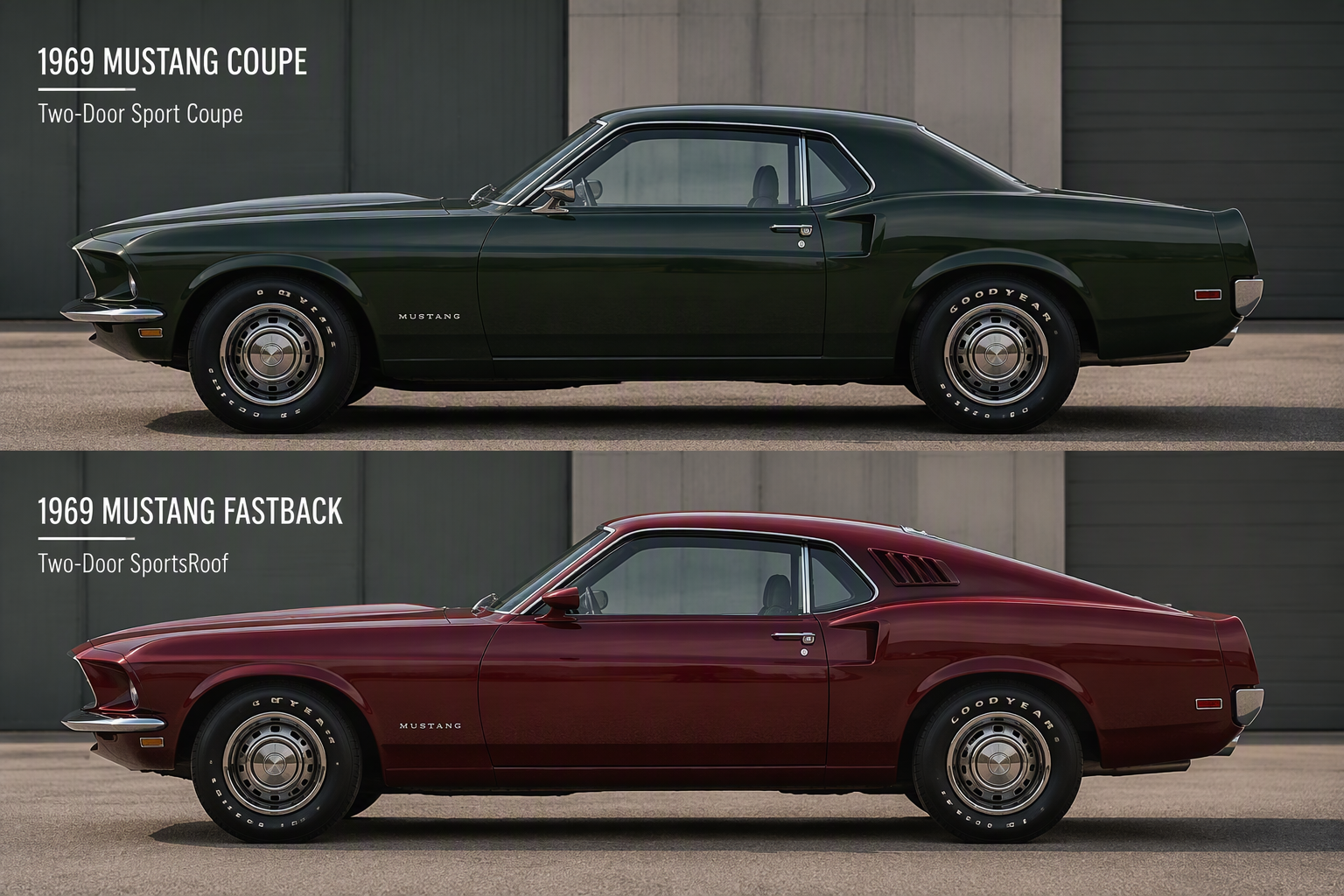
Changing a body style can produce a beautiful car. It does not rewrite how the vehicle left the factory.
9. Price the car you are actually buying
Imagine five visually excellent 1969 Mustangs:
Car A: Genuine factory fastback retaining highly original specification
Car B: Genuine factory fastback restored with a replacement but correct-type engine
Car C: Genuine factory fastback converted into a high-quality modern restomod
Car D: Factory coupe professionally converted into a fastback
Car E: Factory fastback modified as a Mach 1 tribute without evidence that it was born a Mach 1
All five may be desirable. Their values may be very different. The correct comparison set therefore depends on identity before condition. Do not compare Car D only with genuine factory fastbacks because it now looks like one. Do not compare Car C only with factory-original examples if the restomod market values its builder, engineering and specification differently. And do not value Car A solely from photographs without establishing that the originality claims supporting its premium are credible.
Hagerty’s current buying guidance makes the same broader point: seller claims should be verified, and a qualified pre-purchase inspection becomes particularly important where VIN/component identity, paint originality or specification affect the purchase.
10. UAE registration adds another layer to modified cars
For a UAE buyer, a heavily modified classic has two separate questions: Is this a good car? And What will be required to register it here?
For Dubai, RTA’s technical-inspection guidance currently defines a classical vehicle as one over 30 years old and sets general safety requirements including suitable tyres, body condition, functioning components, brakes, lighting and an engine operating without fuel, lubricant or coolant leakage. RTA also specifically states that vehicles with modified bodies may be transferred to the Technical Inspection Committee.
Its current FAQ goes further. For substantial engine or body modifications, a vehicle that is already modified and imported from outside the UAE can be transferred to the technical committee for assessment.
The Ministry of Industry and Advanced Technology also publishes UAE technical regulation relating to safety requirements for modified vehicles within the national conformity framework.
This does not mean that every restomod, engine swap, replica or body conversion will be refused registration. It means you should not assume that foreign registration automatically guarantees a routine UAE registration process.
Requirements may depend on the vehicle, the nature of the modification and the emirate in which it will be registered. For a substantially modified overseas car, investigate this before purchase rather than after shipping.
CLASSICS R US INSIGHT A US title tells you how the vehicle is documented there. It does not promise how a substantially modified vehicle will be treated by a UAE inspection authority. For major engine, body, chassis or structural changes, check the likely registration path before committing your money.
How do you verify what the car really is? Begin by writing down the seller’s material claims.
For example:
- “matching numbers”;
- “original engine”;
- “factory colour”;
- “genuine Mach 1”;
- “one-owner”;
- “never restored”;
- “original panels”;
- “frame-off restoration”;
- “Shelby continuation”;
- “professionally built replica”;
- “no structural modifications”.
Then ask a simple question beside each claim: What evidence would prove or materially support this? Different claims require different evidence.
Factory model/body style: VIN/chassis decoding, data plate, factory build record, marque registry
Original engine: Engine number/stamping, factory, records, date codes, marque specialist
Factory colour: Data plate/build sheet, hidden original paint areas, restoration records
Original body: Historic photographs, seams/welds, inspection, restoration photographs
Genuine rare derivative : Factory records, recognized registry, marque specialist, correct identifiers
Quality restoration : Before/during photographs, invoices, builder information, physical inspection
Professional restomod: Builder records, component invoices, engineering inspection, road test
Replica/continuation identity: Manufacturer documentation, chassis origin, title, registry where applicable
For valuable cars, combine documentation with physical inspection. Documents can be wrong. Parts can be changed. Identification plates can be moved. Old advertisements can repeat earlier mistakes. The strongest conclusion comes when the documents, physical car and historical record tell the same story.
When should you use a marque specialist? A normal pre-purchase inspector may be excellent at finding leaks, rust, worn brakes and suspension play. That does not necessarily make them qualified to authenticate a rare derivative.
Use marque-specific expertise when:
- “matching numbers” materially affects price;
- genuine and replica versions can look very similar;
- the model has high-value factory variants;
- engine or chassis stampings require specialist interpretation;
- the car has been heavily reconstructed;
- factory records exist but need interpretation;
- competition history or unusual provenance is claimed;
- something in the documentation does not make sense.
For an originality-sensitive car, the right specialist may save far more money than they cost.
For a modified car, the specialist you need may instead be a restoration engineer or fabricator who can judge whether the work is structurally and mechanically sound.
The expertise should match the question.
A practical identity-and-originality checklist
Before paying a premium for what a classic is claimed to be, ask:
- Does the physical chassis/VIN agree with the ownership documents?
- Have I decoded the vehicle using reliable model-specific
information?
- What body style did it leave the factory with?
- Is the claimed high-value derivative supported by factory or
registry evidence?
- What does “matching numbers” mean for this particular marque and
year?
- Is the engine original to this car, period-correct or simply the
correct type?
- Has the body been substantially repaired, rebodied or converted?
- Which major panels and structural sections have been replaced?
- Is the current colour the original colour?
- Is the interior original, restored to original specification or
redesigned?
- What modifications have been made to the engine, transmission,
brakes, suspension, steering and structure?
- Who performed the restoration or modification work?
- Are invoices and progress photographs available?
- If the car is a tribute, replica, recreation or continuation, is
that status clearly documented?
- Does the asking price compare with cars of the same actual identity,
not merely the same appearance?
- Has an independent inspector physically checked the car?
- If identity materially affects value, has a marque specialist
verified it?
- If substantially modified, have I investigated the likely UAE
inspection and registration path?
If you cannot answer the questions that create the car’s price premium, do not simply assume the seller’s adjectives are correct.
Conclusion:
Originality is not automatically better. Modification is not automatically worse. A survivor can be historically fascinating but mechanically tired. A restored car can be magnificent while containing very little untouched factory material. A restomod can sacrifice originality and become a far better car to drive. A tribute can deliver the appearance of a rare model without pretending to have its pedigree. A replica can be beautifully engineered and deeply enjoyable. The problem is not which category the car belongs to.
The problem is paying for one category while unknowingly buying another.
Establish the vehicle’s identity first. Then understand its originality. Then judge its condition and workmanship. Then decide whether that particular combination suits the way you intend to own and use the car.
And finally, price that car not the badge on its boot lid, the silhouette it resembles, or the story you hoped was true.
CLASSICS R US INSIGHT A replica honestly sold as a replica can be an excellent purchase. So can a restomod, tribute or converted car. Transparency is what matters. Know what you are buying, know what has changed, and pay for the car that actually exists.
If you are considering a classic overseas and want help understanding its identity, specification, documentation or modifications before committing, contact Classics R Us by phone or WhatsApp.
IMPORTANT INFORMATION
This Guide is intended as practical buyer education, not legal, regulatory, valuation, engineering or registration advice. Terms such as “original”, “matching numbers”, “survivor”, “restomod”, “tribute”, “clone”, “replica”, “recreation”, “continuation” and “rebody” do not have one universally applied commercial definition and may be used differently by sellers, manufacturers, clubs, auction houses and authorities.
Vehicle identity and authenticity should be assessed using evidence appropriate to the specific marque and model. Where originality or provenance materially affects value, buyers should consider independent marque-specialist authentication in addition to a general pre-purchase inspection.
UAE inspection, modification and registration requirements can vary according to the vehicle, the nature of its modifications and the relevant emirate. Dubai RTA guidance cited in preparing this Guide should not be assumed to apply unchanged throughout the UAE. Requirements and procedures can change. Buyers considering substantially modified, rebodied, reconstructed, engine-swapped or replica vehicles should confirm the applicable requirements before committing to purchase.
Regulatory information checked in September 2026.