How to Read a Classic-Car Listing and What the Seller Isn’t Telling You
A classic-car listing is not a complete description of the vehicle. It is a collection of claims, photographs, omissions and opinions. The skill is learning which statements are facts, which are assumptions, and which questions the advertisement has quietly left unanswered.
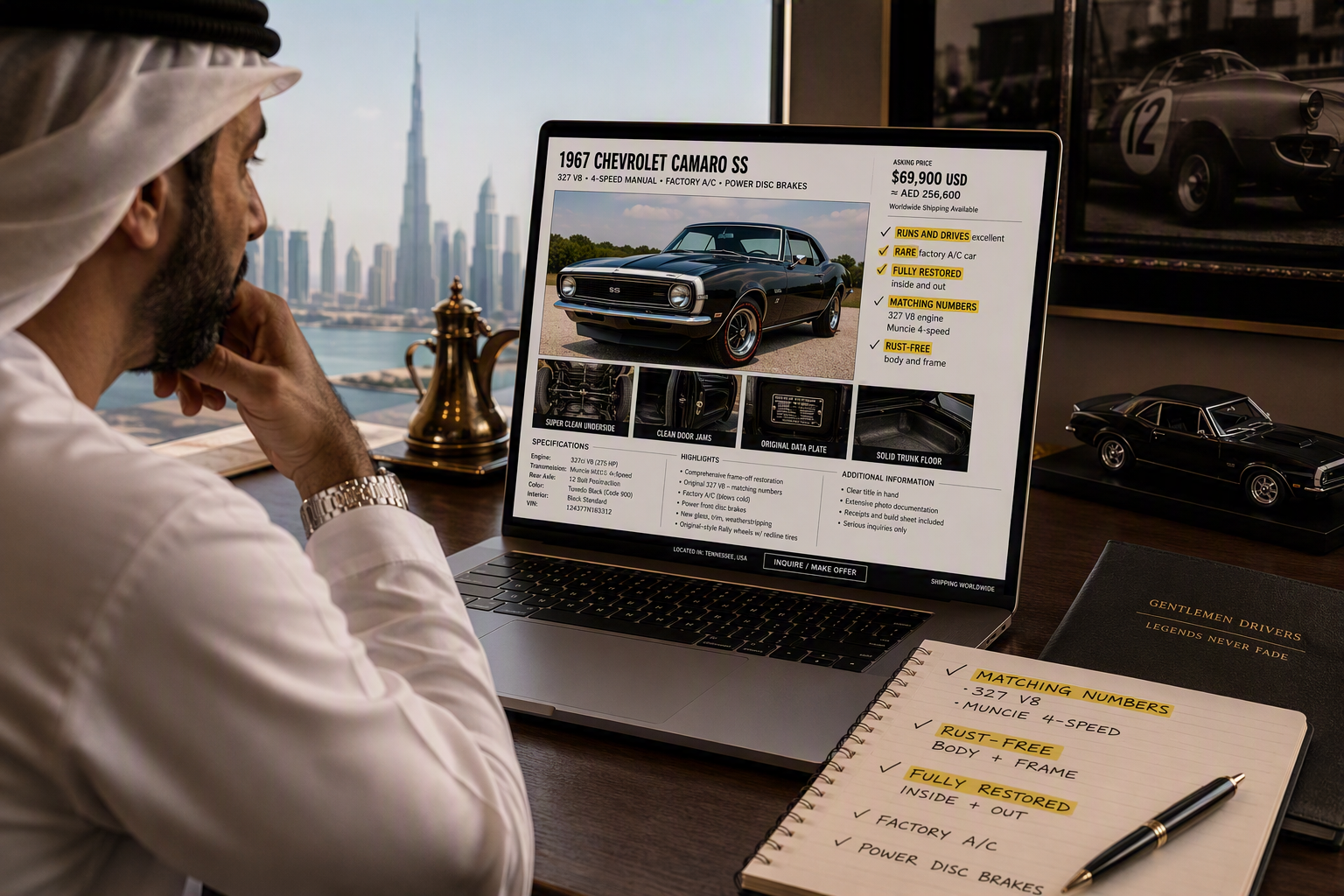
Introduction
A good classic-car advertisement can tell you a lot. A bad one can tell you almost nothing. And a beautifully written one can still leave out the exact thing you most need to know. That does not mean every seller is hiding something.
Classic cars are old. Their histories are often incomplete. Cars change hands. Engines get replaced. Restorations happen decades before the current owner arrives. Invoices disappear. Previous owners tell stories that nobody can now prove.
The mistake is therefore not trusting a seller. The mistake is treating every sentence in the advertisement as though it has the same evidential value.
“Retains its original engine.” “Powered by a correct-type V8.” “The seller believes the engine to be original.” Those three sentences may describe cars that look identical in photographs. They do not make the same claim.
The same applies to phrases such as “rust-free”, “no known rust”, “fully restored”, “runs and drives” and “ready to drive anywhere”. Each tells you something. None should be allowed to tell you more than it actually says.
The objective is not to become suspicious of every adjective. It is to learn how to turn sales language into questions, and questions into evidence.
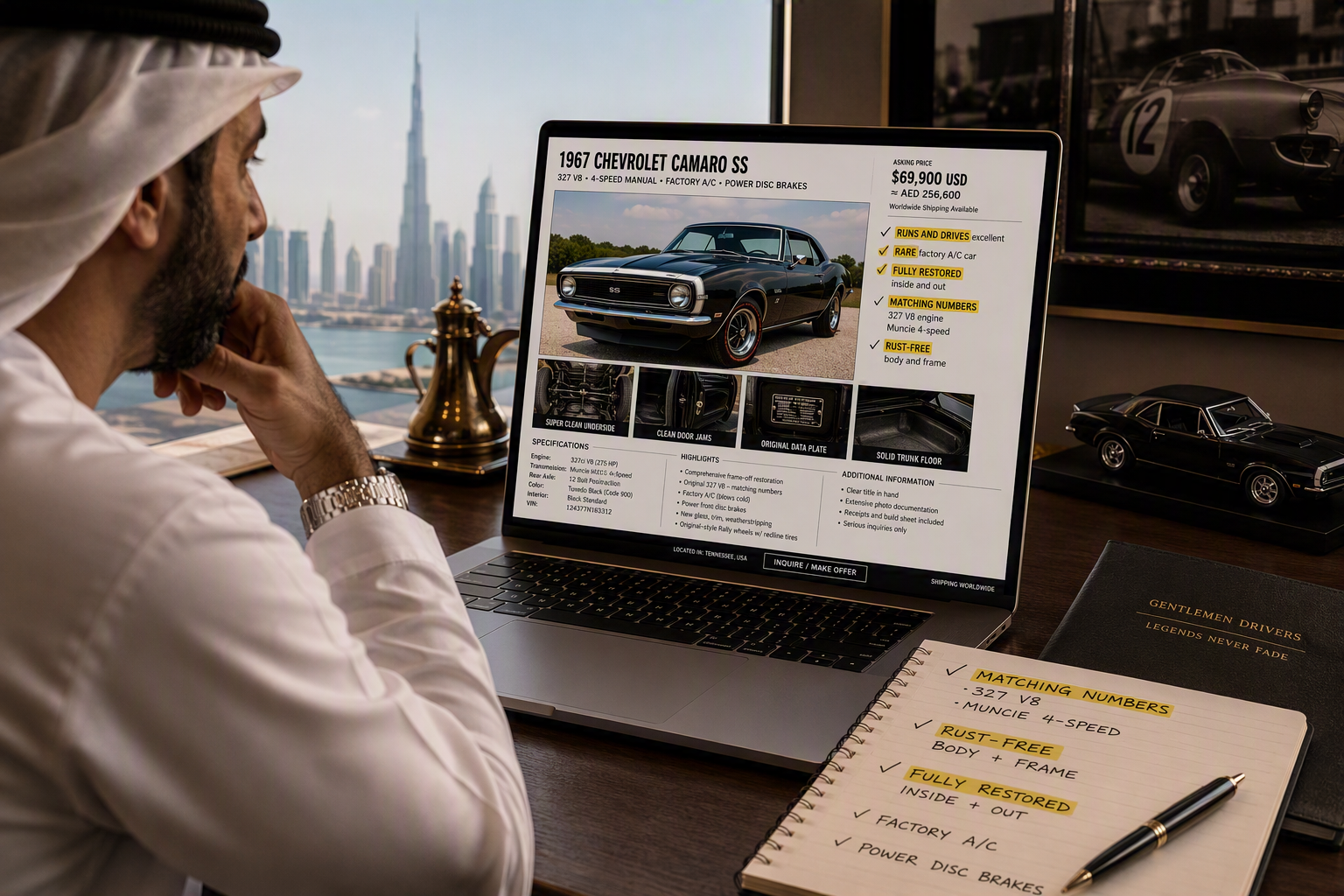
The listing is where your investigation begins not where it ends.
1. Read the grammar before you read the car
The wording of a classic-car listing often tells you how confident the seller or auction house is in the claim.
A useful mental hierarchy looks like this:
Wording - What it usually means
“Retains its matching-numbers engine” - The advertiser is presenting the statement as fact
“Factory build sheet confirms…”- The claim is linked to identified documentary evidence
“Seller states…” - The advertiser is repeating the seller’s representation
“Reportedly…” / “believed to be…” - There is some basis for the statement, but uncertainty remains
“Appears to retain…” - This is primarily an observation, not proven history
“Excellent”, “investment grade”, “drives great” - This is opinion until converted into something measurable
That hierarchy is visible in the way serious auction houses describe cars.
A careful catalogue may say a car was “reportedly delivered new” to a particular country, or that it is “said to have remained” with one owner. That qualification is not necessarily a red flag. It can be responsible writing. If records are incomplete, the honest wording is often “believed” rather than pretending certainty. What matters is whether the language matches the evidence.
Watch the attribution words: When you see:
- reportedly;
- seller states;
- according to the previous owner;
- believed to be;
- thought to be;
- appears to be;
- claimed to be;
pause and ask: Who actually knows this? and: What is the basis for the claim?
“According to the previous owner, the engine is original” does not mean the engine is original. It means the current seller received that information from somebody else. That may still turn out to be correct. But the value of the statement changes.
Likewise: “Period-correct engine” does not mean original engine. “Correct-type 427” does not mean factory-installed 427. “One of 200” does not become factual because somebody typed it in capital letters.
CLASSICS R US INSIGHT: Careful wording is not dishonesty. In many cases, “believed original” is more trustworthy than an unsupported declaration of originality. The important question is not how confident the wording sounds. It is what evidence sits behind it.
2. Convert every important adjective into a question
Classic-car advertisements depend heavily on adjectives because adjectives are efficient.
“Excellent.”
“Original.”
“Solid.”
“Restored.”
“Rare.”
“Road ready.”
“Investment grade.”
Each sounds informative. Most are incomplete.
“Driver quality” Usually, this means the car is intended to be used rather than shown at concours level. But it does not tell you whether:
- the paint is poor;
- the chrome is tired;
- the car leaks oil;
- the steering has play;
- the brakes need work;
- the interior is worn;
- or all of the above.
Ask: “What cosmetic and mechanical defects would I notice if I were standing beside the car?” That is a much better question than: “Is it a good driver?”
“Runs and drives”: This is one of the most commonly misunderstood phrases in project and lower-priced classic listings. “Runs and drives” can mean: it starts; it goes into gear; it moves under its own power.
It does not necessarily mean: it stops well; it tracks straight; it runs cool; it can sit in traffic; the gearbox is healthy; it can complete a long journey; it is safe; or it is roadworthy.
Ask: “How far and how recently have you driven it?”.
“Rare” or “one of X”
The smaller the claimed production number, the more important the source becomes.
Ask: “What factory, registry or recognised marque source establishes that number?”
If nobody can answer that, the rarity may still be true. It simply remains unverified.
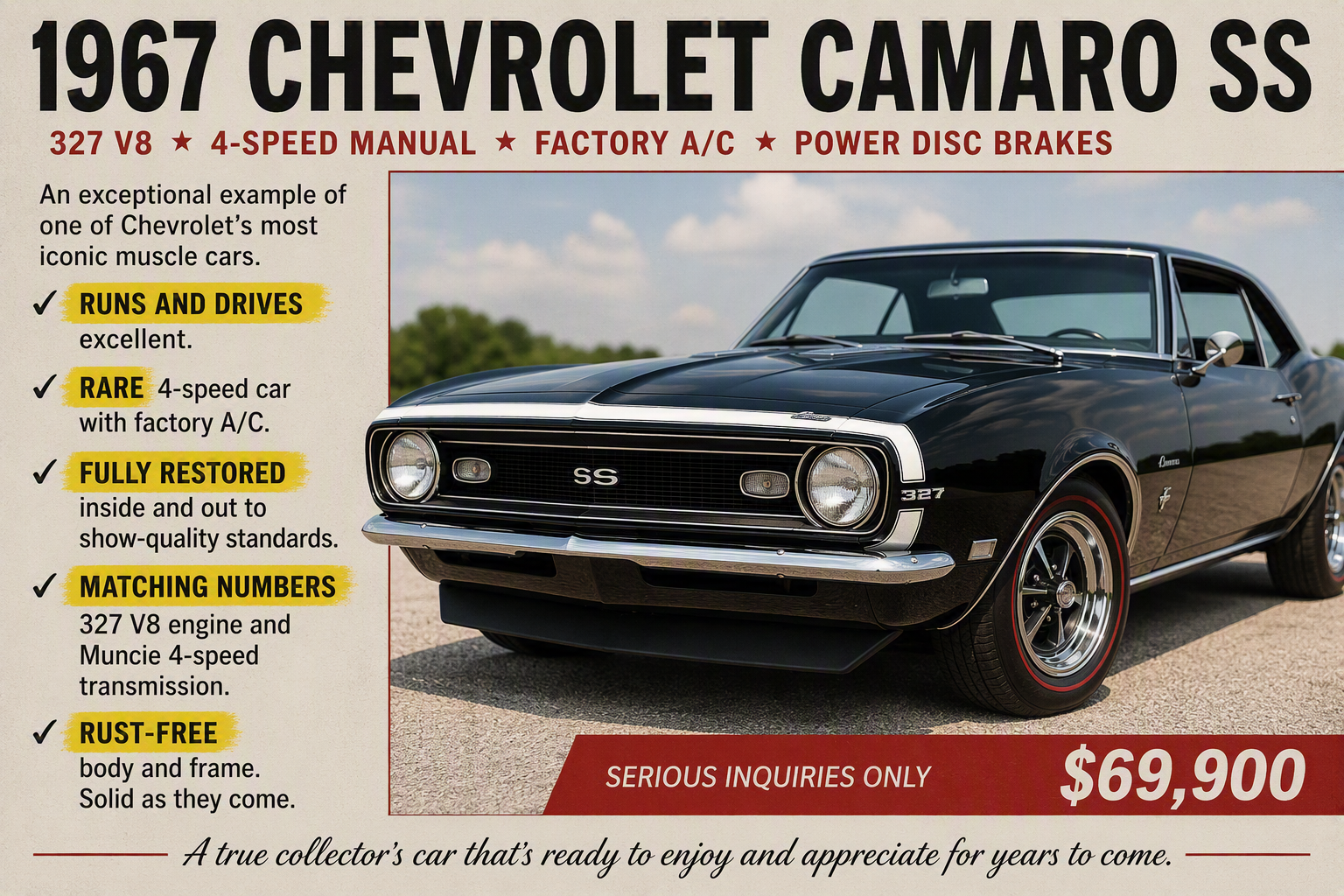
The strongest words in the advertisement should generate the strongest follow-up questions.
3. “Restored” is not a specification
“Restored” may be the most abused word in the classic-car market. A seller may use it to describe: paint and upholstery; an engine rebuild; a body repair; a mechanical refresh; a ten-year restoration; a complete bare-shell rebuild; or simply work performed by a previous owner. The word alone tells you almost nothing about scope.
“Fully restored” - Ask: When? By whom? To what standard? What was dismantled? What remained untouched? Was the drivetrain rebuilt? Was the wiring replaced? Was rust removed or covered? Are there invoices? Are there photographs from during the work?
“Frame-off restoration” - On a body-on-frame vehicle, this should mean something literal: the body was removed from the chassis. If the seller uses that phrase, it is perfectly reasonable to ask for photographs of the body separated from the frame. If no such photographs exist, that does not automatically mean the claim is false. But the easiest evidence of the claim is missing.
“Rotisserie restoration” - This normally implies that the body or shell was mounted on a rotating fixture so the underside and difficult areas could be properly accessed. Again, ask for photographs.
“Nut-and-bolt restoration” - This usually implies an unusually comprehensive dismantling and rebuild. But it is not a regulated certification. Ask the simplest possible question: “What was not dismantled or restored?”
The age of the restoration matters. A car restored in 2006 is not a newly restored car in 2026. It may still be magnificent. It may also have accumulated: paint ageing; corrosion; seal deterioration; suspension wear; fluid leaks; storage damage; electrical problems; or thousands of kilometres.
Do not buy the restoration as it existed when completed. Buy the car as it exists today.
CLASSICS R US INSIGHT: A serious restoration should leave a trail: invoices, photographs, a restorer’s name, parts records and a date. The more the restoration is being used to justify the asking price, the more reasonable it is to expect that evidence.
4. The photographs are part of the description including the photographs that are missing
The number of photographs is not the same thing as the quality of the evidence.
Seventy glamour photographs can reveal less than twenty deliberately chosen diagnostic photographs.
A strong set should help answer three different questions:
What is the car?
What condition is it in?
What has happened to it?
What useful photographs should include
Area - What you are trying to learn
Straight front, rear and side views - Symmetry, stance and panel relationships
Panel gaps - Adjustment, replacement panels or possible previous repair
Rockers/sills and lower quarters - Common corrosion and repair areas
Door bottoms and shuts - Rust, overspray, paint transitions and restoration quality
Engine bay - Specification, wiring, leaks, repairs and originality
Boot/trunk floor and spare-wheel well - Corrosion, patches and water damage
Floors and underside - Rust, repairs, structural condition and old accident damage
Frame/chassis rails - Corrosion, deformation, patching and fresh coating
Suspension mounting points - Structural integrity and repair quality
VIN/chassis tags and number stamps - Identity and originality claims
Interior wear - Condition and consistency with mileage/originality claims
Restoration photographs - What was under the finished paint
Older photographs - How the car changed before the current presentation
Learn to notice absence. A seller may provide dozens of photographs yet omit the exact area relevant to the strongest claim. No underside photographs do not prove a bad underside. They mean the underside remains unanswered. A matching-numbers claim without number photographs remains unsupported. Fresh black underseal does not prove concealment, but it is reasonable to ask for photographs taken before the coating was applied. A newly painted or restored car without progress photographs deserves the same approach: ask what work was performed and what documentary evidence survives.
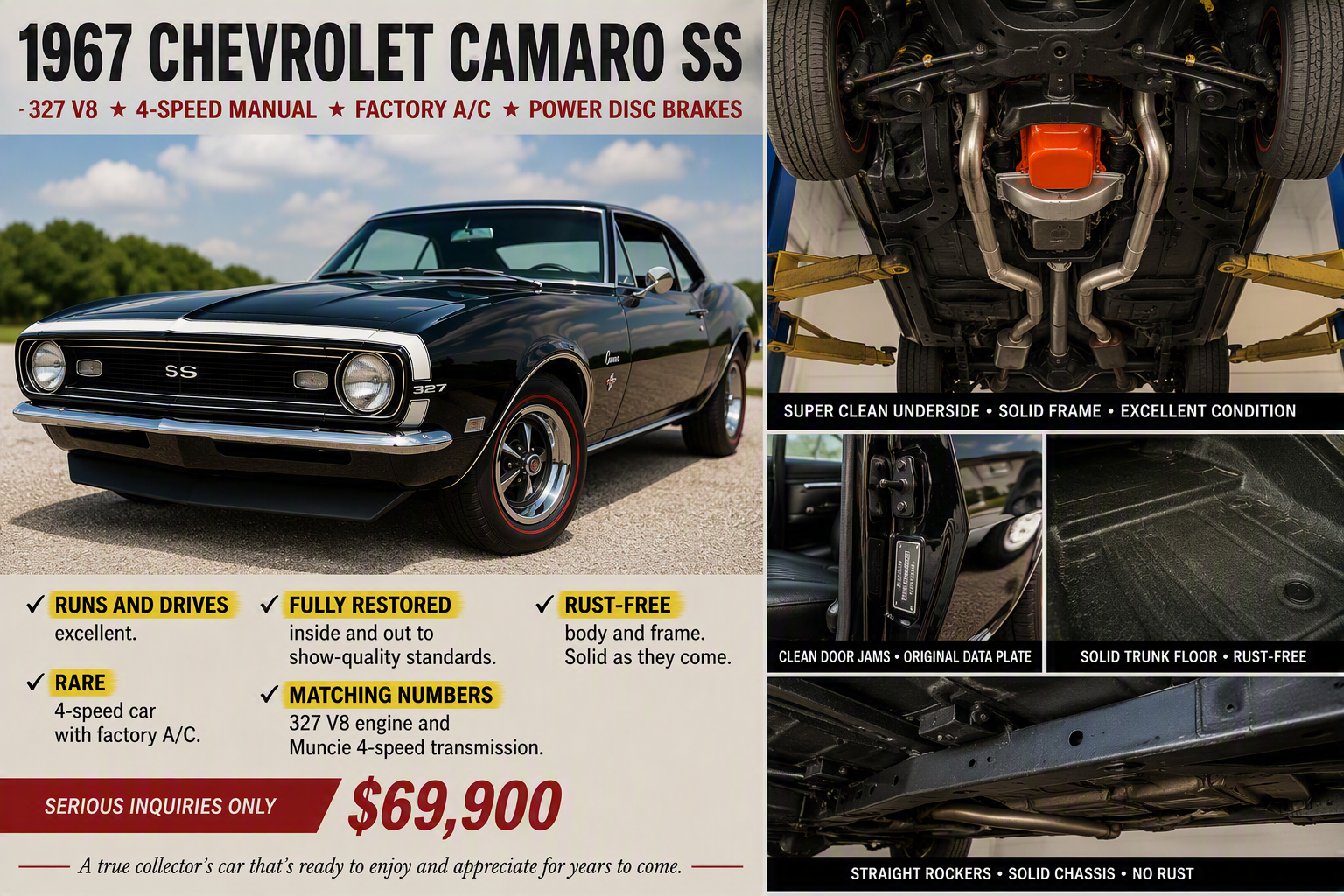
Presentation photographs sell the car. Diagnostic photographs help you understand it.
Read paint and panels carefully. Photographs can sometimes reveal: inconsistent colour between panels; different gloss levels; overspray; masking lines; orange peel; waviness in reflections; bubbling; poor panel alignment; unusual seams; fresh coating; visible patch repairs.
But photographs also mislead. Lighting changes colour. Wide-angle lenses distort lines. Reflections can exaggerate or hide waviness. A suspicious photograph should therefore become a request for better evidence, not a diagnosis.
5. Rust language deserves special attention
“Rust-free.” “No rust.” “No known rust.” “Solid.” “Solid underneath.” “Minor surface rust.” “Typical rust.” “Some bubbling.” These phrases are not interchangeable.
“Rust-free” is a strong claim. Ask whether the seller means no visible rust today, no structural rust, no perforation, or no previous rust repair. A properly repaired car may be rust-free today without having been rust-free throughout its life.
“No known rust” is weaker and often more responsible. Ask what has actually been inspected and whether the car has been viewed on a lift.
“Minor surface rust” should become a location-and-extent question: where is it, how large is it, and is any metal perforated?
“Some bubbling” tells you only what is visible at the surface. It cannot tell you how far corrosion extends beneath the paint.
Geography is context, not proof. A dry-state history may reduce concern and a long life in salted winter conditions may increase it. But “California car” or “Arizona car” should never be translated automatically into “rust-free”. Where the car lived matters; how it was stored and repaired matters more.
CLASSICS R US INSIGHT: Never let a geographic label replace photographs. “Dry-state car” is useful context. It is not an inspection report.
6. Mechanical phrases need scope, not enthusiasm
Classic-car mechanical descriptions are full of words that sound precise but are not.
For “engine rebuilt”, ask who did the work, when, why, what machining and internal parts were involved, and whether a build sheet or machine-shop invoice exists.
“Engine refreshed” is usually less specific. Ask the simplest useful question: “What exactly was done?”
“New brakes” needs the same treatment. Pads or shoes alone and a complete hydraulic/brake-system overhaul can both be advertised as “new brakes”. Ask for the component list and invoice.
“Recently serviced” Again: What exactly was serviced? An oil change is a service. So is a major ignition, valve-adjustment, carburettor, cooling and fluids programme. Ask for the invoice.
“A/C blows cold” Useful, but ask when it was last serviced, how long it has remained charged and whether it has been tested properly. For a UAE buyer, an A/C system that feels acceptable on a mild morning overseas may behave very differently here.
“Everything works” Ask: “Is there anything, any gauge, switch, window, light, horn, wiper, heater control or accessory that does not work exactly as intended?”
That forces the seller away from the general statement and towards specifics.
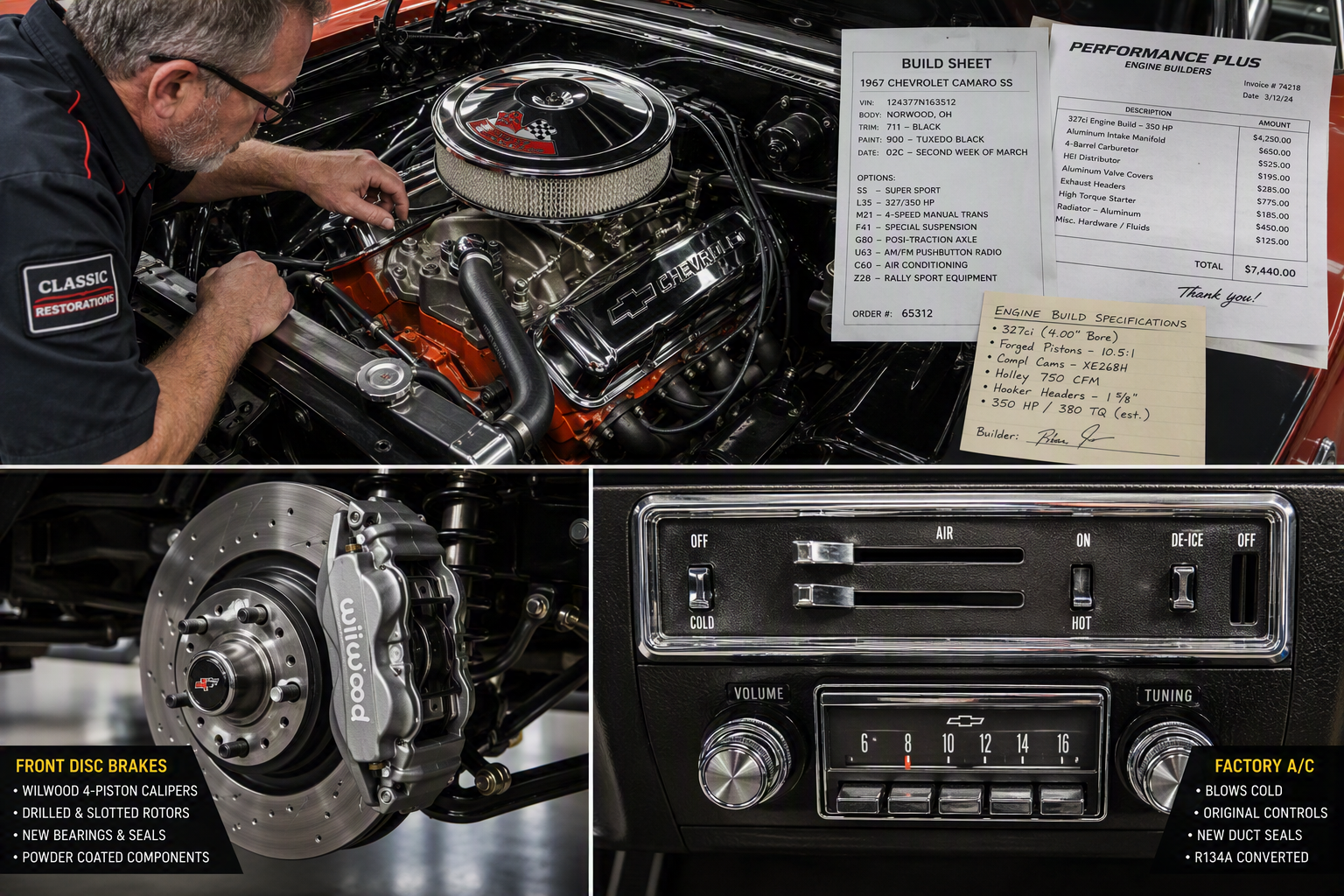
Mechanical claims become useful only when the scope of the work is defined.
7. Originality, mileage and rarity should earn their premium
If a seller wants more money because of originality, mileage or rarity, the evidence should increase with the price premium.
“Matching numbers” Ask for: chassis/VIN; engine number; transmission number where relevant; casting or date codes where relevant; the source used to interpret them; specialist verification for high-value cars. Do not assume every manufacturer used the same system.
For “original paint”, ask whether any panel has been refinished, blended or replaced, and what history or inspection evidence supports the claim.
For an “original interior”, ask what has been retrimmed, recoloured, repaired or replaced.
For “low mileage”, remember that an odometer reading is not the same thing as lifetime mileage. Ask for a dated trail of service, registration, inspection or ownership records.
For “one owner”, ask for the ownership chain.
For “one of 200”, ask for the source.
And for “documented”, ask the obvious question: “Documented by what?” Three recent invoices and a factory-to-present history file are both “documentation”, but they do not tell you the same story.
8. Title wording can sound reassuring while proving less than you think
For a UAE buyer looking at a US car, ownership documents deserve attention before meaningful money is committed.
“Clean title” Do not silently translate this into: never crashed; never flooded; never repaired; no rust; original body. Those are different issues. Ask to see the actual title. Where appropriate, check available US title-history information.
“Clear title” Ask what the seller means. Does it mean: in the seller’s name? no lien? no brand? immediately transferable? all of the above?
Terms such as “salvage”, “rebuilt”, “bill of sale only” and “lost title” can have jurisdiction-specific meanings. They do not automatically kill a transaction, especially with older vehicles, but they do mean ownership and export documentation should be understood before money is committed. If the title is in somebody else’s name, ask why and what proves the seller’s authority to transfer the car.
CLASSICS R US INSIGHT: A title adjective is not a substitute for the title. If the paperwork matters to the transaction, ask to see the document before you spend serious money on inspection, shipping or purchase.
9. Price is also telling you a story
An asking price is not merely a number. It contains assumptions. Suppose a car is substantially more expensive than apparently similar examples. Ask: What must be true about this car for that premium to make sense?
Perhaps: the engine must genuinely be original; the mileage must be credible; the restoration must be exceptional; the colour/specification must be rare; the provenance must be unusually strong; the condition must be materially better.
Good. Now you know what to verify.
The same logic works in reverse. If the car is unusually cheap, ask what explanation would make the price rational: motivated seller, poor advertisement, undesirable specification, old restoration, mechanical needs, rust, missing documents or an incomplete project.
Low price is not proof of fraud. High price is not proof of quality.
Projects deserve special caution. “Easy project”, “needs TLC”, “just needs paint” and “needs finishing” should be translated into an itemised work list.
Ask what remains to be done and what parts are missing. Rare trim, glass, brackets, dashboard pieces or model-specific hardware can be harder and more expensive to replace than the obvious major components.
And “just needs paint” may still conceal rust repair, panel alignment, stripping, metalwork and substantial reassembly. The purchase price is often the least expensive part of a bad project.
10. The seller’s behaviour is additional evidence
Do not judge a seller by charm. Judge what happens when reasonable questions are asked.
Positive behaviour includes sending specific photographs, producing the title and invoices, acknowledging defects, permitting independent inspection and saying “I don’t know” when the answer genuinely is not known. None of that guarantees a good car, but it makes uncertainty easier to manage.
Do not confuse inconvenience with dishonesty. A private seller may be poor with technology, need time to access a stored car or simply not know specialist terminology. That does not make the car bad.
Conversely, a beautifully presented dealer listing can still describe a poor car. What matters is whether the specific unanswered question becomes clearer after you ask.
Patterns matter. One refusal is not necessarily meaningful. Repeated resistance that follows the weakest part of the listing is different.
Examples: A seller claims “matching numbers” but repeatedly avoids sending number photographs. A seller claims “rust-free” but supplies every requested image except the underside. The title description changes during the conversation. The claimed restoration date changes. The seller pressures you to send irreversible money while documentation remains unresolved.
At that point, you are no longer dealing with a simple omission. You are dealing with a pattern that needs to be resolved before proceeding.
A practical claim → evidence → question framework
Before becoming emotionally attached to a car, write down the claims that create its value.
Then use this structure:
Claim - Evidence to request - Question to ask
Frame-off restoration - Body/frame separation photos, invoices, builder details - “Who performed it, when, and can I see the body off the chassis?”
Nut-and-bolt restoration - Full work file and progress photos - “What was not stripped, inspected or rebuilt?”
Rust-free - Underside, known rust zones, restoration photos - “Does that include previous rust repairs?”
Matching numbers - Number photos and marque-specific verification “Can you send the relevant stamps and the source used to verify them?”
Original paint - History, jamb photos, inspection evidence “Has any panel ever been repaired, blended or refinished?”
Low mileage - Continuous dated mileage records “What documents support the mileage over time?”
One of X - Factory/registry/marque source “Which recognised source establishes that figure?”
Engine rebuilt - Builder and machine-shop documentation “What exactly was machined or replaced?”
New brakes - Itemised parts/labour invoice “Which brake components are actually new?”
Recently serviced - Dated invoice “What precisely did the service include?”
Original interior - Detailed photos and history “What has been repaired, recoloured or replaced?”
Clean title - Actual title and appropriate history checks “Whose name is on the title, and has it ever carried a brand?”
Complete project - Photographic parts inventory “What is missing, damaged or known to be unusable?”
Investment grade - Provenance, condition and credible comparables “What objective attributes justify the premium?”
This is the discipline that matters. Claim. Evidence. Question. Not: Adjective. Excitement. Deposit.
When should you pause? Not every weak listing is a bad car. Not every omission is sinister. A useful scale is:
Situation - Response
Sparse wording, average photos, seller does not know an obscure detail - Normal. Ask questions.
No underside photos, vague restoration description, unclear mileage wording - Clarify before spending inspection/travel money.
Strong claims with little evidence, inconsistent dates, unexplained fresh underseal, title story changes - Slow down and independently verify.
Seller cannot demonstrate lawful ownership, identifiers conflict, refuses reasonable independent inspection, demands irreversible payment while major questions remain unresolved - Pause until independently resolved.
The most useful warning signs are often not defects. They are mismatches.
Strong claim + weak evidence.
Premium price + undocumented premium attribute.
Huge photo set + conspicuous omission.
Specific question + repeated non-answer.
Restoration superlative + no identifiable restorer, date or records.
Rarity claim + no source.
Title adjective + no title copy.
That is much more useful than a generic “20 red flags walk away” list because each mismatch tells you exactly what needs to be resolved.
A practical listing-reading checklist
Before you book an inspection or commit serious money, ask yourself:
- Which statements in the advertisement are facts?
- Which are supported by documents?
- Which are attributed to the seller or previous owner?
- Which are opinions?
- Which important claims remain unverified?
- Does the seller define what “restored” actually means?
- Is the restoration date clear?
- Are there current underside photographs?
- Are known rust areas shown?
- Are VIN/chassis and engine numbers shown where they matter?
- Do the photographs appear to come from the same period?
- Are restoration-progress photographs available?
- Does “rust-free” include previous rust repair?
- Does “matching numbers” mean original to the car or merely correct type?
- Does “low mileage” have a documentary trail?
- Is a rarity claim supported by a recognised source?
- Have I seen the actual title or ownership document?
- Does the asking price depend on assumptions I have not verified?
- When I ask for specific evidence, does the seller provide it?
- Have any important explanations changed?
- What does the listing still not tell me?
The last question may be the most important.
Conclusion
A classic-car listing should not be read as a verdict. It should be read as a starting file.
The best advertisements make your job easier by separating: documented facts; seller representations; qualified historical claims; observations; and opinions.
The weaker ones mix all of those together. Your job is not to become cynical. It is to become precise.
When you see:
“rust-free” — ask where the evidence is.
“matching numbers” — ask for the numbers.
“fully restored” — ask what was restored.
“engine rebuilt” — ask by whom and what was done.
“one of 200” — ask who says so.
“low mileage” — ask for the history.
“clean title” — ask to see it.
“ready to drive anywhere” — ask where it has actually been driven.
A cautious seller may own a superb car, while a polished catalogue may still describe a car with serious faults. Presentation quality and vehicle quality are not the same thing. What matters is whether the material claims that create the car’s desirability and price survive the journey from sales language to evidence.
CLASSICS R US INSIGHT: Do not ask yourself whether you believe the advertisement. Ask which statements you can verify, which remain representations, and which important questions the advertisement has not answered yet.
If you have found a classic overseas and want help understanding the listing, identifying the unanswered questions, or deciding what should be verified before you commit, send the listing to Classics R Us by phone or WhatsApp.
IMPORTANT INFORMATION:
This Guide is intended as practical buyer education, not legal, valuation, mechanical, title, inspection or authentication advice.
Classic-car listing terminology is not universally standardised. Words and phrases such as “restored”, “frame-off”, “nut-and-bolt”, “concours”, “matching numbers”, “original”, “survivor”, “rust-free”, “driver quality”, “clean title” and “investment grade” may be used differently by sellers, auction houses, dealers, appraisers, clubs and jurisdictions.
Photographs, videos and advertisements can help identify questions but cannot reliably establish hidden corrosion, structural integrity, internal mechanical condition, authenticity, previous repairs or future reliability. Buyers should use an appropriate independent pre-purchase inspection and, where value depends heavily on provenance or originality, a marque specialist.
US title and registration practices vary by state. Terms such as “salvage”, “rebuilt”, “bonded”, “bill of sale only” and other ownership descriptions can have jurisdiction-specific meanings. UAE buyers considering overseas vehicles should confirm that ownership and export documentation are suitable for the intended transaction and destination before committing funds.
Examples and terminology in this Guide are intended to illustrate how claims should be investigated, not to suggest that qualified wording, missing photographs or incomplete records automatically indicate dishonesty.
Research checked in September 2026.